


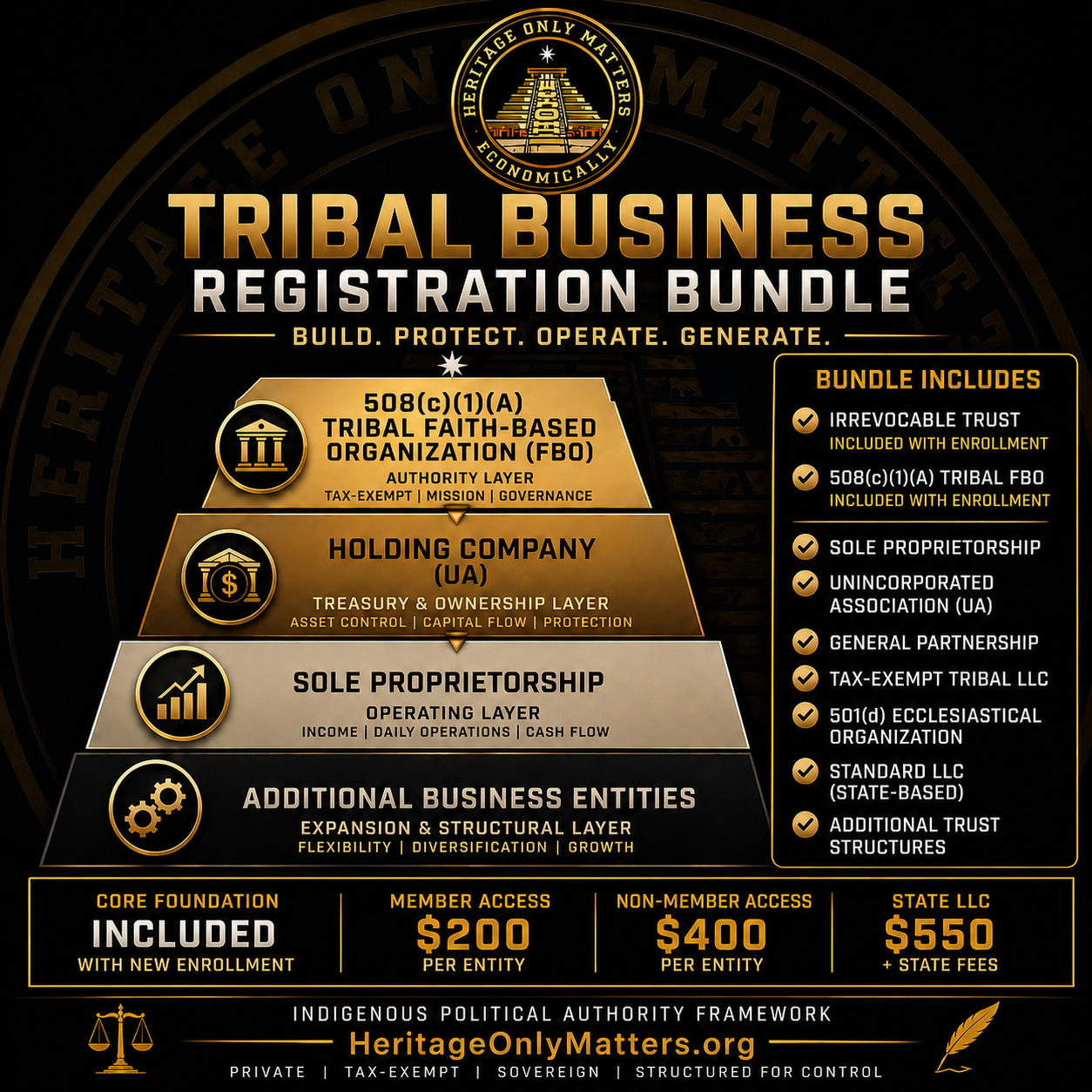
Types of Entities
-
Best for: Ministries, councils, community programs, education, religious commerce
Ecclesiastical entity under tribal authority
May receive tax-exempt donations
Often paired with:
Holding Company
Trust
Operating LLC or Sole Proprietorship
-
Best for: Independent operators, consultants, service providers, and small operations seeking simplicity, flexibility, and lawful Indigenous structuring.
A Tribal Unincorporated Association (UA) is an Indigenous business form used when an individual or group operates without forming a state-registered corporation. When operated by a single administrator, the UA may function operationally as a sole proprietor.
Key Characteristics
Indigenous tribal business form
No Secretary of State filing required
EIN issued through Indigenous Government process
Administrator appointed by notarized minutes
May open bank accounts
DBA / Trade Name Requirement
When operating publicly, opening accounts, or contracting, the UA typically uses a DBA (Doing Business As) filed at the county level.
This allows the UA to function commercially while remaining outside state corporate jurisdiction.Tax Treatment & Reporting
When operated by a single administrator:
The UA may be treated as a sole proprietorship for tax history
Income and expenses may be reported using Schedule C
Allows lawful tracking of:
business income
operational expenses
deductible costs
Important:
“Sole Proprietorship” here refers to tax reporting treatment, not a separate organizational entity.Common Use Cases
Consulting & professional services
Independent contractors
Education, wellness, creative services
Early-stage or low-overhead operations
Entities operating under a 508(c)(1)(A) or Holding Company
-
The Holding Company business is designed to be used when there is a need to hold assets via a company.
The holding company acts basically as a sole proprietor holding assets or accumulating assets for a business venture.
This is the entity to be used with a Tribal LLC to hold the assets for a Tribal LLC and Open a Bank Account for the Tribal LLC. It has its own EIN and Articles to do so. It is also registered at the county level with a trade name registration to access opening a bank account.
The Articles of Organization require notarization in the US jurisdiction
-
The Tribal LLC business is designed to be used when there is a need to do business without Liability and there is no need for licensing to operate the business
This is the entity to be used with a Holding Company to Open a Bank Account. It has its own EIN and Articles to do so. It is NOT registered at the county level with a trade name registration to access opening a bank account.
The Articles of Organization require notarization in the US jurisdiction
-
The LLC Standard is a business designed to be used when there is a need to operate licenses bid on contracts and operate where there is high interface with business entities that require taxing etc.
This is the entity to be used with all business requiring certain certifications background checks better business bureau registrations licensing state and federal contracts. It is also registered at the county level with a trade name registration to access opening a bank account along with a full Secretary of State Registration.
The Articles of Organization require notarization in the US jurisdiction
-
The General Partnership business is designed to be used when there are multiple partners operating within a business venture.
It has its own EIN and Articles to do so. It is also registered at the county level with a trade name registration to access opening a bank account.
The Articles of Organization require notarization in the US jurisdiction
-
The 501 (d) business is designed to be used when there is agriculture or a need to use property tax exemption with a property or piece of land.
This is the entity to be used after filing for a determination letter from the IRS. This is done via form 1024 with the IRS. The Organization must express its Indigenous religious or apostolic tenets. We relate this to agriculture and plant medicine amongst Indigenous tribes who carry out religious plant ceremony grow the plants themselves and do so according to Indigenous Pawahtun tradition (Equinoxes/ Solstices). Any property in the indigenous Jurisdiction can participate in the agriculture and plant ceremony side and this use the 501 (d) method).
It has its own EIN and Articles to do so. It is also registered at the county level with a trade name registration to access opening a bank account.
The Articles of Organization require notarization in the US jurisdiction.
-
The Trust is designed to be used in Indigenous Jurisdiction or state statutory jurisdiction. The Trust does these things:
a) Seeds property to a beneficiary
b) Converts property to the Indigenous Jurisdiction via Affidavit and amendment to the trust for the new property that is unincumbered with any debt (requirement)
c) Allows and Institution or the Indigenous Government to act on behalf of an Institution or Indigenous person
The Trust can be kept private in the tribe (initial trust). It can also be recorded at a county recorders office in the US jurisdiction when it covers property etc where a notice is required in order to enforce protections (houses, cars etc that were formerly in US jurisdiction.
It has its own EIN and Articles to do so. It is also registered at the county level with a trade name registration to access opening a bank account.
The Articles of Organization require notarization in the US jurisdiction
-
An Indigenous Irrevocable Trust is established to protect property held by a tribal member whose rights are recognized under Indigenous law and supported by federal statutes, including the Snyder Act (25 U.S.C. § 13).
The Snyder Act affirms the federal responsibility to protect Indigenous persons and their property, recognizing their legal capacity to own, manage, and secure assets within the United States. This trust operates within that protected capacity.
Key Functions:
Secures property and assets for an Indigenous beneficiary
Establishes continuity of ownership and use
Protects estate interests across jurisdictions
Coordinates with 508(c)(1)(A) entities, holding companies, and operating businesses
Important Conditions:
Trust is irrevocable while the beneficiary remains in good standing
Assets placed into trust must be lawfully owned and generally unencumbered
Trust does not extinguish valid contractual obligations


“If you don’t pay taxes, you’re smart”
-Donald J. Trump
Social Proof Testimonials:
Tax Exempt Investment Account opened via Fidelity
